5 Signs Your Young Athlete Is Ready for Sports Performance Training | Impact Sports Performance
Every parent of a young athlete eventually asks the same question: "Is my kid ready for sports performance training?" It's a great question, and not always an easy one to answer. Start too early without the right foundation, and you risk frustration or injury. Wait too long, and your athlete may fall behind peers who are already building real speed, strength, and athleticism.
The good news? There are clear signals to look for. At Impact Sports Performance, we've worked with hundreds of youth athletes across Michigan, from beginners just falling in love with sport to high schoolers preparing for college recruitment and we've learned exactly when a young athlete is ready to take the next step.
Here are the 5 signs your young athlete is ready for sports performance training.
Sign #1: They're Coachable and Ready to Be Challenged
The most important trait we look for in young athletes isn't physical, it's mental. Before any bar is lifted or any drill is run, an athlete needs to be coachable.
Coachability means your child can:
Listen to and follow instructions from a coach
Accept correction without shutting down or acting out
Stay focused during structured sessions
Try again after failing or struggling
This doesn't mean your athlete needs to be perfect, no one is. But if they can engage meaningfully with a coach, take feedback, and push through discomfort, they're ready to benefit from structured training.
Most kids reach this level of emotional readiness somewhere between ages 10 and 13, though every child is different. Our coaches at Impact are experienced in working with athletes at all maturity levels, creating an environment that challenges and supports young athletes simultaneously.
Is your athlete ready to be coached?
Our experienced coaches specialize in developing young athletes in a positive, structured environment. Every athlete starts with an evaluation.
Sign #2: They've Mastered Basic Movement Patterns
Sports performance training is built on a foundation of fundamental movement. Before a young athlete can safely and effectively train for speed, power, or strength, they need to demonstrate control of their own body.
Look for these foundational movement competencies:
Squatting with proper knee and hip alignment
Landing from a jump without collapsing the knees inward
Running with a basic upright posture and arm swing
Performing a simple lunge or step pattern without losing balance
Carrying and controlling their own bodyweight through basic exercises
If your athlete is still developing these basics, that's completely okay, it just means they may benefit most from our foundational programs. Our
Youth Sports Performance program and Middle School Sports Performance program are specifically designed to build these movement skills before layering on more advanced training demands.
Athletes who already demonstrate strong movement competency are ideal candidates for more advanced programming.
Sign #3: They Have a Genuine Desire to Improve
Motivation is the fuel that makes sports performance training work. And we don't mean pressure from a parent, we mean the athlete themselves has something to prove, a goal to chase, or a drive to be better.
This intrinsic motivation doesn't need to look the same in every athlete. Signs of genuine desire to improve include:
Asking questions about how to get faster, stronger, or more skilled
Voluntarily watching game film or practicing on their own
Expressing frustration when their performance doesn't match their expectations
Talking about goals for their sport, making varsity, earning a scholarship, beating a rival
When athletes have genuine buy-in, the results are dramatically better. Training sessions become more focused, athletes push harder, and progress comes faster. Our coaches are skilled at identifying and channeling this internal drive into purposeful, productive work.
If your child is showing up because they want to, not because you told them to, that's one of the clearest signs they're ready.
Motivated athletes get results faster.
Let our coaches channel your athlete's drive into structured, science-based training. See what our programs can do.
Sign #4: They're Physically Mature Enough to Handle Structured Training
This is where many parents have questions — and understandably so. "Is it safe for my 12-year-old to lift weights?" The research-based answer is yes — when training is age-appropriate, properly supervised, and correctly programmed.
Physical readiness for sports performance training doesn't mean your athlete needs to be big or strong. It means they have enough physical development to:
Follow movement patterns safely under coaching supervision
Handle low-to-moderate training loads without compromising form
Recover appropriately between training sessions
Articulate physical discomfort (so coaches can adjust accordingly)
For most youth athletes, this readiness emerges in middle school, typically between grades 6 and 8 — though early sport specialization can accelerate readiness in some cases. Conversely, athletes who are not yet in competitive sports may benefit from waiting until they have more structured sport experience.
Our Middle School Sports Performance and Advanced Sports Performance programs are structured to match the athlete's physical development stage, not a one-size-fits-all template.
If you're unsure where your athlete falls, our evaluation process is designed exactly for that, we assess each athlete individually before recommending a program.
Sign #5: They're Experiencing a Performance Plateau or Competitive Gap
Sometimes, the clearest sign that an athlete needs sports performance training is a frustrating stall in progress. They're practicing hard, competing consistently, but they're not getting faster, not gaining explosive power, or watching peers pull ahead despite similar effort.
This plateau often happens because traditional sport practice alone isn't enough. Practicing your sport develops sport-specific skills; sports performance training develops the underlying physical qualities, speed, power, agility, strength, and endurance, that make those skills more effective.
Look for these performance plateau signals:
An athlete who trains hard but isn't gaining speed or power
A player who gets outrun, out-jumped, or outmuscled despite good technique
An athlete who gets injured more frequently than peers
A young athlete expressing frustration about their physical limitations
If your athlete is hitting this wall, structured sports performance training may be exactly what breaks through it. Our coaches know how to identify the physical limiters holding an athlete back and build programming to address them directly.
Break through the performance plateau.
Our science-based training programs are built to unlock the speed, power, and strength your athlete needs to compete at the next level.
How Impact Sports Performance Assesses Readiness
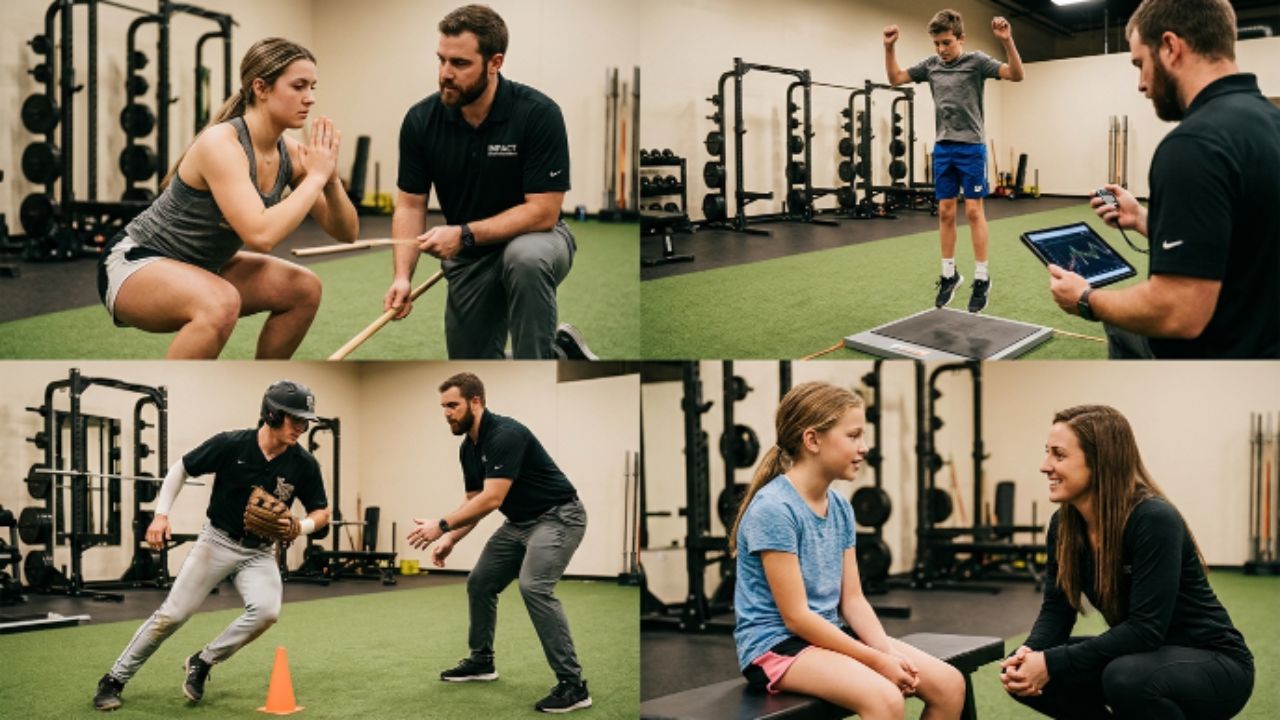
Not sure how many of these signs your athlete shows? That's exactly why every athlete at Impact Sports Performance starts with a comprehensive evaluation.
Our evaluation process looks at:
Movement quality and mobility how the athlete moves through fundamental patterns
Physical performance benchmarks speed, power, and strength baselines
Sport demands and goals what does success look like for this specific athlete and sport?
Mindset and coachability is the athlete emotionally ready to train?
From there, we match the athlete to the right program whether that's our Youth Sports Performance, Middle School, or Advanced Sports Performance program. Our coaches bring real-world sports and coaching experience; meet our coaching staff here.
Frequently Asked Questions
What age should a child start sports performance training?
Most children are ready to benefit from structured sports performance training between ages 10 and 13, depending on their physical and emotional maturity. We offer programs for middle school athletes and high school athletes. When in doubt, start with our evaluation we'll tell you exactly where your athlete stands.
Is weight training safe for young athletes?
Yes when properly supervised and age-appropriately programmed. Research consistently shows that youth resistance training is safe and beneficial when coaches use correct technique, appropriate loads, and proper progression. At Impact Sports Performance, all training is supervised by certified coaches experienced in youth athlete development.
How is sports performance training different from playing a sport?
Sport practice develops sport-specific skills: dribbling, passing, shooting, etc. Sports performance training develops the underlying physical qualities speed, power, agility, strength, and endurance that make those skills more effective. Both are essential for elite athletic development.
What sports do you train for at Impact Sports Performance?
We train athletes across all sports football, basketball, baseball, softball, soccer, volleyball, lacrosse, hockey, track and field, and more. Our programming focuses on universal athletic qualities that transfer across all sports.
Where are Impact Sports Performance locations in Michigan?
We have three locations in Michigan: Novi (inside TOCA Training Center), Brighton (inside Turnin' 2 Softball Training Center), and East Lansing (inside East Lansing Ice Cube). View all locations and contact information here.
How do I get started?
Every athlete at Impact Sports Performance starts with an evaluation. It's the best way for our coaches to understand your athlete's current ability and build the right development plan. Schedule your evaluation here.
Ready to Take the Next Step?
If your young athlete is showing any of these signs, don't wait. The athletes who develop the right physical foundation now are the ones who dominate their sport in high school and beyond.
At Impact Sports Performance, every athlete starts with an evaluation so we can build the exact right plan for where they are and where they want to go. Our coaches are committed to developing faster, stronger, more confident athletes, one athlete at a time.
Become Faster. Stronger. Unstoppable.
Start with a free evaluation at our Novi, Brighton, or East Lansing location. Our coaches will assess your athlete and build the right development plan.