Strength Training for High School Athletes: The Complete Guide
If you coach, train, or parent a high school athlete, you already know the difference between a program that builds champions and one that just burns kids out. Strength training for high school athletes is one of the highest-leverage investments a young athlete can make, but only when it’s done right. This guide covers everything you need to know: the science, the structure, the safety, and the specific strategies that separate elite high school conditioning programs from the rest.
Whether your athlete is a freshman stepping into the weight room for the first time or a senior looking to earn a college scholarship, this complete guide will help you understand exactly how to train smart, stay healthy, and unlock athletic potential.
Ready to Train Like a Champion?
Discover how Impact Sports Performance builds elite high school athletes through science-based strength and conditioning programs.
Explore Our High School Training Programs
Why Strength Training Is Essential for High School Athletes
Gone are the days when coaches told young athletes to avoid the weight room for fear of stunting their growth. Modern sports science is unequivocal: properly designed strength and conditioning programs are not just safe for high school athletes they are essential for long-term performance and injury prevention.
The Research-Backed Benefits
A well-structured high school strength conditioning program delivers measurable advantages across every sport:
Increased power output, speed, and explosiveness on the field or court
Significantly reduced risk of common sports injuries, including ACL tears and stress fractures
Improved body composition and sport-specific endurance
Greater mental resilience, discipline, and coachability
Long-term athletic development that transitions to college and beyond
Did You Know?
Studies show that youth strength training can reduce sports injuries by up to 68% when implemented correctly.
High school athletes who train consistently in the weight room are 2-3x more likely to earn college athletic opportunities.
Contrary to old myths, strength training does NOT stunt growth in adolescent athletes.
The Fundamentals of High School Strength Training
Not all training is created equal. Before loading a barbell, every coach and athlete must understand the foundational principles that make a program safe, effective, and appropriate for the developmental stage of a teenage athlete.
1. Prioritize Movement Quality Before Load
The most important rule in strength training for high school athletes: technique always comes before weight. Young athletes are still developing neuromuscular patterns, and grooving proper movement mechanics early creates an athletic foundation that pays dividends for years. Rushing to add weight leads to compensations, bad habits, and injuries.
2. Progressive Overload, The Engine of Improvement
The body adapts to stress. To keep getting stronger, athletes must gradually increase the demands placed on their muscles over time. This can mean adding weight, increasing reps, shortening rest periods, or improving exercise complexity. A well-designed program manages this progression systematically rather than randomly.
3. Age-Appropriate Programming
A 14-year-old freshman needs a very different program than a 17-year-old senior. Younger athletes should focus heavily on bodyweight movements, coordination, and foundational strength. Older, more advanced athletes can handle greater complexity, higher training volumes, and sport-specific power development.
4. Periodization: Train in Cycles
Elite high school conditioning programs are built around periodization, the strategic cycling of training phases throughout the year. This typically includes an off-season phase focused on building general strength, a pre-season phase emphasizing power and sport-specific preparation, and in-season maintenance to stay sharp without overloading the athlete.
5. Recovery Is Part of the Program
Sleep, nutrition, and rest days are not optional extras, they’re where the adaptations actually happen. High school athletes who neglect recovery undermine every hour spent in the gym. Coaches at Impact Sports Performance consistently emphasize that recovery is a skill that must be taught and developed alongside physical training.
Train Smarter, Not Just Harder
Our certified coaches at Impact Sports Performance design individualized programs that match each athlete’s development stage, from freshman foundations to senior performance peaks.
Schedule Your Free Athlete Assessment Today
Core Exercises Every High School Athlete Should Master
While sport-specific training has its place, every high school strength training program should be built around a foundation of fundamental multi-joint movements. These exercises develop total-body strength, coordination, and athleticism that transfers across all sports.
The Big Five Movements
Squat Variations (Goblet, Back, Front) the foundation of lower body power, hip mobility, and athletic positioning
Hip Hinge (Romanian Deadlift, Trap Bar Deadlift) builds posterior chain strength critical for speed and injury prevention
Upper Body Push (Push-Up, Dumbbell Press, Bench Press) develops pressing strength and shoulder stability
Upper Body Pull (Rows, Pull-Ups, Lat Pulldown) builds the pulling strength and posture that protects the shoulder
Core Anti-Rotation (Planks, Pallof Press, Dead Bug) develops the functional core stability that transfers directly to sport
These movements, performed with correct technique and appropriate loading, address the majority of athletic demands across virtually every high school sport. Mastery here is far more valuable than chasing exotic or Instagram-trending exercises.
Sample Weekly Training Structure for High School Athletes
Here’s an example of what a well-designed in-season strength and conditioning week might look like for a high school athlete:
Note: This is a general template. The ideal program for your athlete will depend on their sport, position, training age, and time of year. Always work with a qualified strength and conditioning coach to build a customized plan.
Safety First: Protecting Young Athletes in the Weight Room
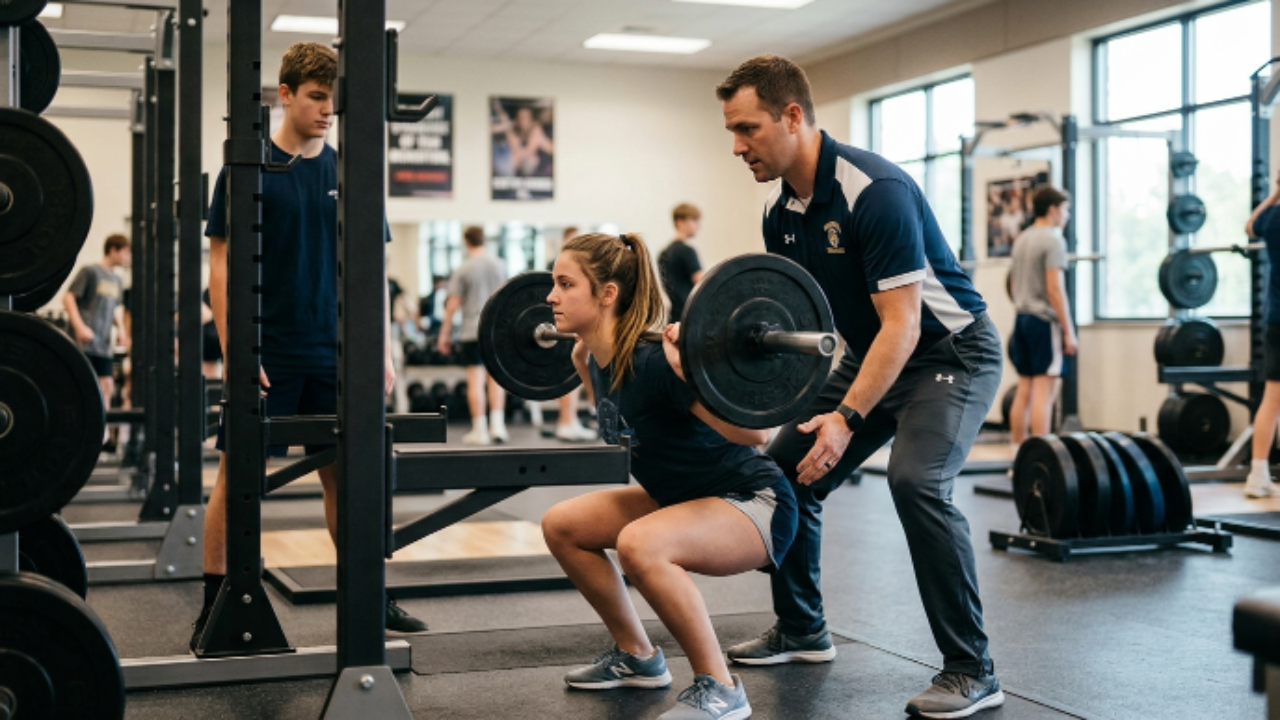
No performance goal is worth an injury. High school strength conditioning must be built on a non-negotiable foundation of safety. Here’s what that looks like in practice:
Thorough dynamic warm-ups prepare joints, muscles, and the nervous system for training loads. Always warm up
New athletes earn the right to use heavier weight by demonstrating technical proficiency first. Teach technique before adding load
Coaches and athletes must know proper spotting techniques and weight room safety rules before training begins. Spotting and equipment protocols
Pain is not the same as productive discomfort. Teach athletes to differentiate between the two. Listen to the athlete’s body
In-season athletes are already under significant physical stress from practice. Strength training volume must be calibrated accordingly. Manage total training load
Safety is Our Standard, Not an Afterthought
At Impact Sports Performance, every program is overseen by certified coaches trained in youth athlete development. Your athlete’s safety is our first priority.
Learn About Our Coaching Philosophy
Fueling Performance: Nutrition Basics for High School Athletes
Strength training creates the stimulus for athletic improvement. Nutrition provides the raw material for the body to actually build that improvement. Many high school athletes are severely underfueling, which limits their results and increases injury risk.
Key Nutritional Priorities
Most high school athletes undereat relative to their combined training and growth demands. Eat enough total calories
Aim for 0.7–1.0 grams per pound of bodyweight daily to support muscle repair and growth. Prioritize protein at every meal
Athletic performance runs on carbohydrates. Complex carbs before and after training are essential. Carbohydrates are fuel, not the enemy
Even mild dehydration measurably reduces strength, speed, and cognitive function. Hydration is non-negotiable
A protein + carbohydrate meal or shake within 30–60 minutes post-training accelerates recovery significantly. Time your nutrition
For personalized nutrition guidance, encourage your athlete to work with a registered dietitian who specializes in sports performance. The right fueling strategy can make the difference between good and great.
How to Choose the Right Strength & Conditioning Program
Not all training facilities are created equal. When evaluating a strength training program for your high school athlete, look for these critical markers of quality:
Certified coaches with credentials in strength and conditioning (CSCS, NSCA-CPT, or similar)
Age-appropriate programming that evolves as the athlete develops
A track record of working with high school athletes across multiple sports
An emphasis on movement quality and long-term development over short-term results
Clear communication with parents, school coaches, and the athlete
A safe, well-equipped, professionally supervised training environment
If you’re in the area, Impact Sports Performance under the direction of Jim Kielbaso has built a proven system for developing high school athletes at every level. From incoming freshmen to Division I prospects, our athletes train with purpose, structure, and expert guidance.
Your Athlete’s Next Level Starts Here
Join the hundreds of high school athletes who have transformed their performance with Impact Sports Performance’s elite training system.
Frequently Asked Questions
Q: Is strength training safe for high school athletes?
Yes when supervised by a qualified coach and programmed appropriately for the athlete’s age and experience level. Research consistently shows that properly designed strength training programs reduce injury risk, improve athletic performance, and support healthy development in adolescent athletes.
Q: How many days per week should a high school athlete lift?
Most high school athletes benefit from 2–3 strength training sessions per week during the season and 3–4 sessions per week in the off-season. The exact volume depends on sport demands, practice schedule, and individual recovery capacity. Quality always matters more than quantity.
Q: Will lifting weights stunt my child’s growth?
No this is a long-debunked myth. Decades of research confirm that youth strength training does not stunt growth when performed with proper technique and appropriate loading. In fact, it supports healthy bone development and reduces the risk of growth plate injuries.
Q: What age should a high school athlete start strength training?
Most athletes can begin a structured strength training program around age 13–14, once they have adequate focus and body awareness to learn proper technique. Younger athletes (11–12) can benefit from bodyweight-focused programs that build coordination and movement patterns. The priority at every age is quality over quantity.
Q: Should strength training be sport-specific?
All high school athletes benefit most from a foundation of general strength training squatting, hinging, pushing, and pulling. Sport-specific elements can be layered on top as the athlete develops. Trying to be too sport-specific too early often limits overall athletic development.
Q: What makes Impact Sports Performance different from other training programs?
Impact Sports Performance was built specifically around the science of long-term athlete development. Under the direction of Jim Kielbaso, our programs are individualized, periodized, and continuously refined based on each athlete’s progress. We don’t run generic group classes we build athletes.
The Bottom Line
Strength training is no longer optional for serious high school athletes it’s a competitive necessity. The athletes who invest in structured, coach-guided strength and conditioning programs arrive at each season stronger, faster, more durable, and more confident than their peers.
The question is no longer whether high school athletes should strength train — it’s who is going to help them do it right.
Ready to Unlock Your Athlete’s Full Potential?
Join the Impact Sports Performance family and train with coaches who are as invested in your athlete’s success as you are.